A garage door opener rarely gets much attention when it is doing its job. You press a button, the motor engages, the door travels smoothly, and the day moves on. The trouble starts when that simple routine slips. Maybe the motor strains. Maybe the door hesitates halfway down. Maybe the remote works only when you are standing unreasonably close. Small faults have a way of becoming disruptive because the opener sits at the center of daily use.
Reliable operation comes from two things working together, the opener itself and the door it is trying to move. That distinction matters. Many people focus on the motor because it is the obvious powered component, but an opener can only perform well if the door is balanced, aligned, and moving freely. When those conditions are off, the opener often becomes the messenger that something else needs attention.
In practical terms, good garage door opener repair is not just about replacing a failed unit. It is about diagnosing whether the problem sits in the motor, the controls, the door hardware, or the way all of them interact. That is also why regular servicing tends to prevent expensive failures. A door and opener that see daily use collect wear in small increments, not all at once.
Why opener problems are rarely only opener problems
A common misunderstanding is that any opening or closing issue must be a motor fault. Sometimes that is true. Gold Coast garage door companies commonly handle motor repairs, motor replacement, and automation upgrades for existing doors, which reflects how often opener systems do need work. At the same time, garage door resource many callouts that begin as garage door opener repair turn into a broader door service because the opener is being forced to compensate for another issue.
Take the case of a garage door not closing properly. That phrase sounds simple, but it can describe several different behaviors. The door may reverse before it reaches the floor. It may stop unevenly. It may close in a jerky motion. It may appear to shut, then lift slightly again. Each of those points to a different pattern of resistance or inconsistency. If the door is out of alignment, if the moving parts are wearing unevenly, or if balance is compromised, the opener often reacts by slowing, stopping, or reversing.
This is why experienced technicians tend to look at the whole system. A motor can be healthy and still struggle because the door is not travelling as it should. The reverse is also true. A perfectly aligned door can still behave poorly if the opener is aging, the controls are failing, or the motor has reached the point where replacement makes more sense than continued repair.
What servicing actually does for reliability
Routine servicing sounds modest, but it usually has a bigger effect than people expect. One Gold Coast provider recommends professional servicing every 12 months to help prevent breakdowns and extend the life of the door and motor. That timing makes practical sense for equipment that is exposed to frequent cycling and changing weather.
A proper service visit is less about one dramatic repair and more about intercepting the pattern of wear before it turns into a failure. On garage doors, that matters because several components age together. Springs wear. Motors lose efficiency over time. Remotes and controls can become unreliable. Fasteners loosen. The result is not always a sudden breakdown. More often, it is a gradual decline that owners adapt to until one day the door stops being dependable.
In coastal areas like the Gold Coast, that decline can move faster. Salt air, humidity, and heat can affect garage door hardware and increase maintenance needs. Even Southport garage door repair services when corrosion is not dramatic, those conditions can shorten the smooth-running phase of parts that are otherwise serviceable. It is the kind of wear you notice first in sound and movement, a little more vibration, a little more drag, a slightly rougher close.
That is why servicing earns its keep in everyday reliability. It keeps a minor issue from becoming a forced repair at the least convenient time, which is often early in the morning when you are trying to leave.
The signs that should not be ignored
Most opener problems announce themselves before they become total failures. The challenge is that people often wait because the door still works part of the time. Intermittent faults are especially easy to dismiss. Then the opener faces a heavier load, the weather changes, or a worn component reaches its limit.
Watch for patterns rather than isolated incidents. If the door operates differently on some days than others, that inconsistency is often meaningful. If the remote response changes, if the motor sounds rougher, or if the closing cycle becomes uncertain, you are looking at wear or misadjustment somewhere in the system.
The most useful warning signs are usually these:
The garage door not closing properly, especially if it stops, reverses, or behaves differently from one cycle to the next. A noticeable change in sound, such as straining, grinding, or an abrupt increase in operating noise. Jerky or uneven travel that suggests the opener is working against resistance. Remotes or controls that become inconsistent, even when the door itself still moves. A door that seems harder for the opener to manage than it was a few months ago.None of those signs automatically means a full replacement is coming. They do mean the system is asking for attention before the problem spreads.
Garage door alignment and why it affects the motor
Garage door alignment tends to be discussed as if it belongs in a separate category from opener performance. In real service work, the two are tightly linked. When the door is not tracking smoothly or is moving unevenly, the opener feels every bit of that resistance.
A homeowner might describe the symptom as, "The motor is running, but the door looks crooked on the way down," or "It starts fine, then seems to catch." Those are the moments when garage door alignment becomes more than a cosmetic issue. Misalignment changes the load pattern. Instead of guiding the door through a smooth path, the hardware introduces friction and imbalance. The opener then works harder, and reliability drops.
This is one reason the phrase fix garage door can be misleading. A proper repair is not always a single-part swap. Sometimes the right solution is to correct the alignment issue first so the opener can return to normal duty. Replacing a motor without addressing a dragging or uneven door may restore operation for a while, but it does not solve the underlying strain.
There is also a judgment call here. If the motor has already been overworked for a long period, correcting the door alone may not fully restore dependable performance. In those cases, opener repair and door adjustment may need to happen together.
Springs change the entire conversation
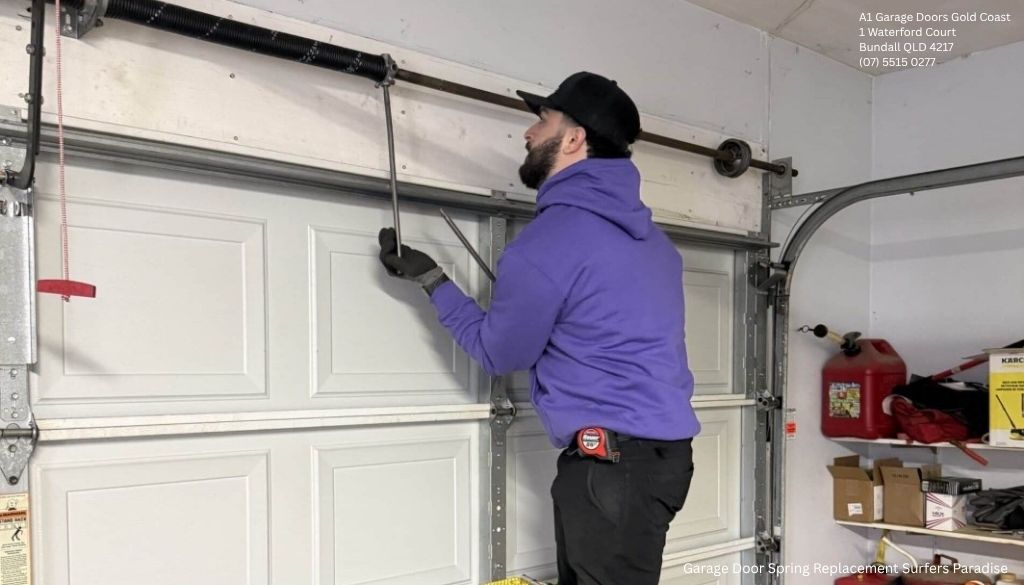
Any discussion of opener reliability has to include springs because they directly affect how much effort the motor needs to move the door. Gold Coast service providers regularly include spring replacement as standard repair work, and for good reason. Springs are part of the core lifting system, not an accessory.
The most important point is safety. Garage door springs are under high tension and are dangerous to adjust or repair without proper training and tools. That is not the kind of warning that exists just to discourage DIY work. It reflects the real energy stored in the system. If a spring breaks or is mishandled, the consequences can be severe.
There is also a practical service point that many owners do not realize. When one spring breaks, both springs may need replacement because they usually wear at a similar rate, and mismatched springs can create balance problems. That matters for opener reliability because a mismatched setup can leave the motor fighting an uneven load. The door may still move, but not as cleanly, and that extra stress shortens the margin for reliable operation.
This is where real-world diagnosis matters. People often assume a failed spring means the opener has failed because the door will not open normally. In fact, the opener may simply be unable to compensate for the lost spring support. Trying to force the issue can risk further damage.
Repair, replacement, or upgrade?
Not every faulty opener should be repaired, and not every aging system needs replacement. The right call depends on what has failed, how the door is moving, and whether the underlying hardware still supports reliable operation.
Repair makes sense when the system is otherwise sound and the fault is contained. Gold Coast garage door businesses commonly handle repairs and replacements of motors, remotes, and springs, which reflects the fact that some parts can be renewed without overhauling the whole setup. If the motor is still appropriate for the door, the controls are serviceable, and the door moves well once adjusted, repair can restore dependable function.
Replacement becomes more attractive when the motor itself is at the end of its useful life, or when repeated fixes are chasing symptoms instead of solving the problem. There is a point where each new repair buys only a short period of relief. Most owners feel that point before they can easily describe it. The opener becomes temperamental. Reliability depends on luck. You start planning around the possibility that the door may not cooperate.
An upgrade can also be the right move when an existing garage door is being automated. Gold Coast providers explicitly offer automation upgrades for existing doors, which makes sense for households that want the convenience of powered operation without replacing the entire door. The key question in those situations is whether the door itself is suitable for that upgrade and in good enough condition to support it.
What a homeowner can reasonably observe
There is a difference between inspecting and repairing. Homeowners can often gather useful observations without crossing into unsafe territory. The safest approach is to pay attention to behavior rather than trying to adjust tensioned or load-bearing parts.
If the door movement is smooth one day and rough the next, that inconsistency is worth noting. If the remote works better at close range than from the driveway, that is useful information during a service visit. If the motor sound has changed from a steady hum to a strained or uneven effort, mention that too. These are details technicians can use to narrow the fault.
What should be avoided is the temptation to "help" the system in ways that conceal the actual problem. Forcing the door, continuing to run an opener that is clearly struggling, or attempting spring work are the kinds of choices that can turn a manageable repair into a larger and more hazardous one.
The most sensible homeowner check is short and simple:
Watch one full open and close cycle from a safe position and note any hesitation, uneven travel, or reversal. Compare current noise and speed to how the system worked when it was operating normally. Check whether the problem affects every control method or only one remote. Stop using the door if it appears unbalanced, jerky, or unusually heavy in operation. Arrange professional service when the problem repeats rather than waiting for a full breakdown.That kind of observation helps without pretending that all garage door faults are home-maintenance tasks.
The Gold Coast factor, weather and wear
Climate shapes maintenance more than many owners expect. On the Gold Coast, salt air, humidity, and heat can all affect garage door hardware. That does not mean every door in the area is in constant trouble. It does mean the environment can accelerate wear, especially on exposed components and on systems that already have minor issues developing.
Heat can change how materials behave over the course of the day. Humidity can contribute to deterioration over time. Salt air can be particularly hard on hardware. In practice, this means a door that might go longer between service visits in a milder inland setting may show symptoms sooner in a coastal environment.
This is one reason yearly servicing is a reasonable baseline rather than an unnecessary extra. In harsher local conditions, regular checks are not just about cleaning up minor inconvenience. They are a way of protecting the opener from working harder than it should for months at a time.
A common pattern in coastal areas is that the first sign is not a dramatic failure. It is a shortening of the system's "forgiving" phase. The door still works, but it becomes less tolerant of small faults. An opener that once handled slight resistance without complaint starts to sound stressed. A door that once shut cleanly now needs a second try. That is the point to act.
Why timely service usually costs less than delayed service
People often delay calling for service because the door still opens and closes often enough to get through the week. That feels economical in the short term, but garage door systems do not usually keep a fault confined to one component forever. A dragging door increases motor strain. A balance issue changes the load on the opener. A spring problem can alter the entire operation of the system.
That does not mean every delay leads to major damage. It does mean that reliability problems tend to travel. The cost of repair is not always just the price of the failed part. It can also include the knock-on effect of running the system while that part was failing.
This is where professional servicing earns a practical rather than theoretical value. It catches the interconnected wear. It gives the opener a fair operating environment. It identifies when a repair is enough and when replacement will save repeated callouts. For households that use the garage as a main entry point, that reliability is not a luxury. It shapes the flow of ordinary life.
The best result is not a dramatic repair
The strongest garage door opener repair work is often the least dramatic from the owner's point of view. The ideal outcome is not a story about a major breakdown fixed at the last second. It is a door that returns to predictable, uneventful operation and stays there. Quiet travel. Consistent response. No hesitation when closing. No sense that the motor is fighting the door every day.
That kind of reliability usually comes from respecting the system as a whole. The opener matters. So do the springs. So does garage door alignment. So does the effect of local conditions, especially in coastal areas like the Gold Coast. A sound diagnosis connects those parts instead of treating every symptom as a separate annoyance.
If your current problem seems minor, that does not mean it should be ignored. If your door is not closing properly, if the motor sounds different, or if the system is becoming inconsistent, those are the moments when sensible servicing pays off. Often, the smartest way to fix garage door problems is to deal with them while they are still small enough to stay simple.